

Show All Definitions
Accreditation refers to a formal quality assurance process through which an external organization evaluates an institution, program, service provider, or organization against established standards. Accreditation is used across education, workforce training, healthcare, industry, and professional sectors to help determine whether quality, effectiveness, safety, governance, learning outcomes, or operational expectations are being met. Accreditation processes may involve peer review, standards evaluation, data analysis, site visits, outcome measurement, continuous improvement processes, industry or employer input, and regulatory alignment
In education and workforce systems, accreditation has traditionally focused on colleges, universities, and academic programs. According to the U.S. Department of Education, accreditation is the process of assessment meant to improve academic quality and institutional accountability by an established set of standards to ensure a basic level of quality. Accreditation covers both the initial and ongoing approval of an educational institution or program. Entire schools or institutions can be accredited (referred to as institutional accreditation), as can individual schools, programs, or departments (referred to as specialized or programmatic accreditation). Accreditation can be conducted on the national, state, or private organizational levels. The accrediting agency establishes an agreed-on set of standards, evaluates organizations or institutions, and then re-evaluates the provider on a set schedule—typically, every five or ten years.
Accreditation models increasingly extend to workforce education, nondegree programs, apprenticeships, online learning providers, industry certification programs, short-term training, and alternative learning pathways.
While accreditation is often carried out by nongovernmental accrediting organizations in the United States that may be reviewed or recognized by federal or state authorities, outside the U.S., quality assurance systems are often more centralized and may operate through ministries of education, professional licensing systems, government agencies, or international standards organizations.
Growing interest in skills-based hiring, digital credentials, workforce mobility, artificial intelligence, and alternative pathways is expanding how accreditation and quality assurance are understood across the broader learn-and-work ecosystem.
Programmatic accreditation is a type of accreditation that evaluates a specific educational, training, certification, or workforce preparation program rather than an entire institution or organization. The review focuses on whether a particular program meets established standards related to curriculum, instructional quality, technical competencies, learner support, industry expectations, safety, outcomes, or preparation for professional practice and employment.
Programmatic accreditation is commonly used in fields where specialized knowledge, technical skills, public trust, safety requirements, or professional licensure are important. Examples include healthcare, engineering, teacher education, information technology, skilled trades, public safety, aviation, manufacturing, and business. Unlike institutional accreditation, which reviews an entire college, organization, or provider, programmatic accreditation concentrates on the quality and effectiveness of an individual program, occupational pathway, or field of study.
Programmatic accreditation may:
Historically, programmatic accreditation was most commonly associated with degree programs and traditional higher education disciplines. However, newer models increasingly apply programmatic accreditation principles to nondegree workforce education, short-term training programs, apprenticeships, industry certification pathways, skills-based learning programs, online and hybrid training providers, workforce bootcamps, and alternative credential providers
Outside the U.S., programmatic accreditation and quality assurance systems vary significantly by country and profession. Some nations rely primarily on government ministries or national licensing systems, while others use professional associations, independent accrediting organizations, or international standards bodies. In globally mobile professions such as healthcare, engineering, aviation, and information technology, programmatic accreditation may support international recognition of qualifications and workforce mobility.
Emerging developments in digital credentials, AI-assisted review systems, competency-based education, and workforce-focused quality assurance are continuing to expand how programmatic accreditation operates across the broader learn-and-work ecosystem.
Degree and diploma mills refer to institutions that offer educational credentials (also known as qualifications) which are not accredited and are not based on common standards of academic assessment. Though the terms are often used synonymously, there are differences between the terms.
Degree mills typically issue diplomas from unaccredited institutions which may be legal in some states but are generally illegitimate. Degree mills may claim to be accredited but they are accredited by fake or phony accreditation agencies.
Diploma mills issue counterfeit diplomas using the names of real colleges or universities. The term is also used to describe a legitimate educational institution that has low academic admission standards and a low job placement rate, such as some for-profit schools.
A third-party organization, GetEducated.com, tracks and maintains a free list of online colleges which do not have proper distance learning accreditation, or which have consumer fraud or scam warnings lodged against it. This service is available for consumer information and protection.
See: Fraudulent Credentials | Learn & Work Ecosystem Library (learnworkecosystemlibrary.com)
Philanthropy and investment firms form funder collaboratives to increase their impact (also called “multiplier impacts”). By pooling resources, funder collaboratives can get more money into a space, rather than just being the sum of donations that would have otherwise gone to the same issue. Working together, funders are able to put larger amounts of money behind impactful ideas, take a wider view of an issue, and take bigger risks.
When a funder collaborative establishes an alliance to direct money into a space, it can also get other philanthropies to put new funding into the cause. By combining larger scale and risk-taking, some funder collaboratives have been able to introduce innovative, effective investment programs that governments and more traditional foundations would not think to support.
Funder collaboratives vary in their legal, financial, and operational structures but generally are structured as “pooled funds” or “co-granting.”
Examples:
The Higher Education Act of 1965, as amended, defines an HBCU as: “…any historically black college or university that was established prior to 1964, whose principal mission was, and is, the education of Black Americans, and that is accredited by a nationally recognized accrediting agency or association determined by the Secretary [of Education] to be a reliable authority as to the quality of training offered or is, according to such an agency or association, making reasonable progress toward accreditation.” HBCUs offer all students, regardless of race, an opportunity to develop their skills and talents. There are currently 107 HBCUs serving more than 200,00 students in 19 states, the District of Columbia, and the U.S. Virgin Islands. HBCUs can be either public or private colleges. While HBCUs historically only served Black students, nearly a quarter of students enrolled in HBCUs as of 2019 were non-Black.
Refers to a structured model or system that outlines the skills, knowledge, behaviors, and attributes needed to perform effectively within an organization or industry. The HCF is commonly used in talent management, recruitment, performance evaluation, and career development processes. Features of an HCF typically focus on:
HCFs commonly include a focus on five personality traits – the labels for these “five big factors” use the acronym “OCEAN:”
Incorporating the five personality traits into an HCF allows organizations to better understand and leverage individuals’ strengths, preferences, and potential areas for development— alongside the other elements of the HCF (e.g., skills, knowledge, and behaviors).
Improvement science is used to accelerate how a field learns to improve. In the field of education, it is a user- and problem-centered approach to improving teaching and learning. It deploys rapid tests of change to guide the development, revision, and continued fine-tuning of tools, processes, work roles, and relationships—with the goal of improving how the field learns to improve.
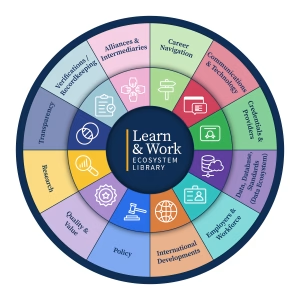
The learn-and-work ecosystem is a connected system of formal and informal learning (education and training) and work. The ecosystem is composed of many building blocks. The Learn & Work Ecosystem Library identifies 12 building blocks (key components) comprising the ecosystem:
When all the building blocks are working together, individuals are able to move more seamlessly through the marketplace using a variety of credentials to communicate the skills and knowledge acquired in multiple settings (e.g., school, work, service, self-study). Employers have more detailed and externally validated information during their hiring and upskilling processes. Schools are better able to count learning obtained outside of academic settings toward a degree or other credential. And the public is informed about our learn and work ecosystem. For the ecosystem to function effectively, all parts of the system must be connected and coordinated.
Alternate term: Education-to-employment ecosystem