A Category in the Learn & Work Ecosystem Library

Skills-Based Hiring 120

Show All Definitions

A comprehensive repository that bridges the worlds of education and employment by capturing an individual’s formal and informal educational experiences, professional development achievements, soft skills, and industry-specific training programs. The approach provides a more complete picture of an individual’s abilities and experiences than is available with traditional academic transcripts and resumes. Employers may use the Wallet to verify and assess credentials, skills, and achievements — this occurs by jobseekers uploading and tagging in multiple formats demonstrations of their skills directly to employers (e.g., a video of a sales presentation or adding a publication to their Wallet).

According to iCIMS (provider of talent acquisition software), AI recruiting is the use of artificial intelligence to streamline and re-automate the recruitment process. AI and machine learning can be used to make manual processes automatic, suggest top candidates for the roles that suit them best, and reduce bias and “gut feeling” when selecting candidates.

Refers to the strategic practice in which large human capital management (HCM) or human resources (HR) technology platforms acquire AI-driven recruiting and conversational platforms—such as chatbots, scheduling assistants, or candidate engagement tools—to create integrated, end-to-end talent acquisition suites. This trend streamlines high-volume frontline hiring of workers and professional recruitment, while also advancing the development of AI agents within enterprise HR ecosystems.

The context for this increasing practice includes:

  • Organizations in sectors such as healthcare, retail, transportation, hospitality, airlines, and entertainment often face persistent high-volume hiring needs.
  • AI-powered conversational platforms (e.g., Paradox, HireVue, Phenom) automate candidate screening, interview scheduling, and communications, easing recruiter workloads.
  • When enterprise platforms like Workday, Oracle, or SAP acquire these tools, they can strengthen their market position, expand offerings to mid-market and enterprise employers, and accelerate their capabilities in skills-based hiring and AI agent development.
  • Industry analysts view this consolidation as part of a broader shift toward “platform convergence” in HR technology, where fragmented point solutions are absorbed into comprehensive HCM systems.

Examples of this practice:

  • Workday’s acquisition of Paradox (announced 2025, expected 2026), integrating conversational AI into its recruiting suite to support end-to-end, AI-powered hiring.
  • iCIMS’ acquisition of Altru (2020), a video storytelling platform, expanding its candidate engagement capabilities.
  • Phenom’s acquisition of Talentcube (2020), adding video recruiting to its AI talent experience platform.

See related terms:

  • Skills-Based Hiring
  • HR-IT Integration
  • Talent Acquisition Platform
  • Human Capital Management (HCM)


Applicant Tracking System (ATS) is an all-in-one human resource (HR) software that automates the hiring process. It helps HR teams manage every part of recruitment (from job posting to onboarding): (1) stores job candidate information, including resumés, cover letters, references, and other recruitment and hiring data that HR teams can easily access and organize; (2) tracks job candidates and their application status throughout the hiring pipeline; (3) weeds out unqualified candidates and recommends the best fit for a position based on the parameters set by HR and only those on the shortlist are moved to the next stage of the hiring process; (4) automates time-consuming administrative tasks such as manually screening applicants, reading resumés, scheduling interviews, and sending notifications and emails to job candidates and employees.

A liberal arts degree is a bachelor’s degree earned in certain liberal arts majors in the humanities, social sciences, natural sciences, and fine arts. A liberal arts degree does not typically focus on a career-specific curriculum as many other college majors do, such as computer science, marketing, engineering, and nursing. Growing employer interest in skills-based hiring is spurring higher education institutions to build into the liberal arts curricula digital and other skills that can help graduates compete for a first job. Applied liberal arts refers to approaches to integrating skills content into liberal arts degrees. Approaches include: 1) offering an Interdisciplinary Bachelor of Arts degree, often known as Applied Liberal Arts (ALA); 2) offering a Bachelor of Science in Applied Liberal Studies as a way of combining the liberal arts foundation with more specialized areas of interest; and 3) integrating skills content (e.g., digital badges, microcredentials) into majors in the liberal arts. The aim of these approaches is to ensure solid grounding in the liberal arts coupled with courses pertinent to the workplace such as project management, data visualization and analysis, design thinking, conflict resolution, public speaking, leadership, dialogue and intercultural exploration, health and wellness, social innovation, personal finance, and entrepreneurship. Skills such as these can be embedded into humanities, math, science, fine arts, and social sciences disciplines – and when this occurs, these are often referred to as applied liberal arts.

Alternative terms: Applied Liberal Studies, Liberal & Applied Studies

The process of evaluating or measuring an individual’s skills, knowledge, or performance against predetermined criteria or standards. Assessment gathers information about what someone knows, understands, or can do to make informed decisions about their progress, abilities, or areas for improvement. Common methods:

  • Written exams/tests that assess knowledge and understanding via questions or prompts presented in written form.
  • Oral exams/presentations that assess verbal communication skills, comprehension, and ability to articulate ideas effectively, commonly taking the form of individual presentations, group discussions, or oral exams.
  • Projects/assignments that require individuals to apply their knowledge and skills to real-world tasks or scenarios.
  • Practical assessments that assess hands-on skills and abilities such as laboratory experiments, artistic performances, or technical demonstrations. They are common in science, art, engineering, and career and technical education.
  • Portfolios compile samples of an individual’s work to demonstrate achievement and competency in specific areas. They often include written essays, artwork, and design projects.
  • Observations assess an individual’s performance or behavior in real-life situations, such as classroom activities, clinical settings, or workplace tasks.
  • Standardized tests assess knowledge, critical thinking, or other formal assessments with uniform administration and scoring procedures.

Assessments often vary within K-12 schools, colleges and universities, and the workplace.

  • Elementary and secondary schools focus on foundational knowledge and skills across various subjects. They may include standardized tests mandated by state or national education authorities, as well as teacher-created assessments tailored to specific curriculum standards.
  • Colleges and universities focus on more specialized, deeper understanding, critical thinking, and application of knowledge within specific disciplines or majors. Assessment methods include exams, research papers, presentations, and practical demonstrations.
  • Employers focus on practical skills, problem-solving abilities, and job-specific competencies relevant to the position. Employers use a variety of methods such as job simulations, interviews, skills assessments, and performance evaluations to assess candidates during the hiring process and evaluate employees’ ongoing performance and development including assessment to guide upskilling/reskilling needs.

Refers to workers who return to their former employers after leaving their jobs. Key benefits of this practice include (1) employees can return to work without much onboarding or training, and (2) recruiters can streamline the hiring process.  Considerations for this practice include (1) the importance of evaluating why the employee left and whether concerns have been addressed, and (2) ensuring employers do not unintentionally communicate to current staff that employees must leave to get a raise or promotion.

To facilitate hiring former employees, employers can focus on an off-boarding process in which they make it clear to employees that their work has been valued, and employees would be welcomed back if an opportunity arises.

In the learn-and-work ecosystem, refers to short-term, specialized and intensive training focused on technical skills, often in the Information Technology (IT) sector (for example, Coder, Web Developer, Software Development, Python Programming Skills). Boot camps are often offered by third-party providers as well as by colleges and universities that partner with third-party providers. Many bootcamps partner with major hiring companies such as Microsoft, IBM, and Amazon.

According to iCIMS (provider of talent acquisition software), candidate relationship management (CRM) software helps employers connect with current and future job candidates to help fill positions faster. CRM makes it possible to build pipelines of talent and efficiently market your recruitment brand to the best candidates through automated email marketing, recruiting event functionality, job recommendation portals and more.

Catfishing by employers: when employees report that the position did not match what was described during the hiring process or the job had more responsibilities than anticipated. This can include:

  • the role did not live up to the description provided by a recruiter or hiring manager
  • the work responsibilities were different than expected
  • the company culture was misrepresented
  • the compensation or benefits were overstated.

Career catfishing by job candidates: when candidates have exaggerated their qualifications or background to land a job. This can include:

  • overstating job responsibilities in previous roles
  • overemphasizing skills or technical abilities
  • boosting their work experience
  • misrepresenting their education or certifications.

Various employer studies have found that catfishing by both employers and job candidates has increased in recent years.

There are a number of titles that speak to how the certificate was earned:

  • Certificate of Achievement
  • Certificate of Participation
  • Certificate of Completion
  • Assessment-based Certificate
  • Course Completion Certificate
  • Bootcamp Course Completion Certificate
  • Online Course Completion Certificate

A measurable, assessable capability of an individual that integrates knowledge, skills, abilities, and dispositions required to successfully perform tasks at a determined level in a defined setting.

Competency-based learning, or competency-based education, often abbreviated as CBE, is a framework for instruction and assessment focused on students demonstrating defined learning objectives or competencies rather than content completion and curriculum schedules.  Students in such a framework typically work at their own pace, using learned knowledge and skills to demonstrate mastery of a subject. At some institutions of higher education, competency-based education courses begin and end throughout the year, independent of a traditional academic calendar.

Competency-based programs transparently communicate the learning objectives students must achieve to earn degrees and other credentials; enable students with existing knowledge and skills to personalize their educations and accelerate progress towards completion; use technology that enables students to learn anytime, anywhere, at prices they can afford’ and integrate support from faculty, mentors, and coaches that can build confidence needed for success, aimed at creating fair and just educational results.

Concurrent or dual enrollment means taking college courses while still in high school. Dual-enrollment courses are taught by college-approved high school teachers in a secondary education environment. Students earn transcripted college credit when they pass the course, based on multiple and varied assessments throughout the course.

According to iCIMS (provider of talent acquisition software), a contingent workforce, or contracted employees, is a workforce that does not have an ongoing contract with a company. The types of contingent workers include:

  • Contractors
  • Seasonal workers
  • Freelancers
  • Consultants
  • Interns

According to iCIMS (provider of talent acquisition software), cost per hire is a key recruiting metric that calculates how much a company spends to fill an open position. It helps talent acquisition leaders answer important questions, like “Are we spending our recruiting budget wisely?” and “How could our hiring processes be refined?”

Refers to the selection and hiring of employees who will bring diverse perspectives and specialized skills to an employer, often filling gaps in existing staff competencies and creating opportunities for growth into new markets. “Culture add” is seen as an improvement on the concept of “culture fit” which can stifle innovation and lock employers into a cycle of hiring only like-minded individuals.

Related term: Culture Fit

According to iCIMS (provider of talent acquisition software), a custom career site is a proprietary website that lists your job openings in an intuitive and appealing way, encouraging visiting candidates to explore your brand and apply for available positions. Unlike third-party job-posting sites, career websites are owned by the company that is hiring, or by a recruiter hiring on behalf of another company. This gives them complete control over the design of the website, the messaging, the language, and the hiring process.

According to iCIMS (provider of talent acquisition software), embracing a data-driven recruitment process makes it possible to find and keep top talent at your company, especially when you incorporate the latest in recruitment metrics and analytics tools.

Moving beyond gut feelings and traditional relationship-building, this evidence-based approach delivers proven results for recruiting and HR teams striving to meet their business objectives—with less waiting, less hassle, and less missed opportunities.

Refers to the practice of employers using degree requirements to screen out otherwise qualified candidates in pursuit of hiring efficiencies.

A digital badge (aka e-badge) is a digital representations of individuals’ achievements, consisting of an image and metadata uniquely linked to the individual’s skills. Digital badges have an issuer (institution that testifies), an earner (learner), and a displayer (site that houses the badge) .Badges can be displayed, accessed, and verified online.

Digital skills are the abilities to use technology including computer software and applications, digital devices (cell phones, tablets, computers), and other computer hardware. Digital literacy skills enable individuals to participate in a range of tasks including:

  • searching and using information on the internet
  • being safe and responsible online
  • communicating and collaborating online or remotely (e.g., through email, audio and video conferencing)
  • shopping, banking, accessing services, applying for a job online, participating in digital platforms
  • searching for, exploring, organizing and sharing data and information appropriately.

In the learn-and-work ecosystem, a three-part framework used to promote the fair treatment and full participation of all people, especially groups historically underrepresented or subject to discrimination on the basis of race/ethnicity, gender, sexual orientation, disability, age, religion, etc.

  • Diversity: the representation of people from a variety of at all levels in an organization, including the leadership level.
  • Equity: fairness and justice, especially related to whether people are being paid or treated fairly in the workforce.
  • Inclusion: the feeling of belonging, feeling heard or valued in an organization.

See MEI – MEI / DEI | Learn & Work Ecosystem Library

A new approach to hiring and workplace diversity is gaining traction across corporate America, challenging DEI (diversity, equity, and inclusion) initiatives. The emerging movement advocates for MEI (merit, excellence, and intelligence), which emphasizes selecting candidates for jobs based solely on their qualifications, abilities, and intelligence. Proponents argue that MEI offers a more equitable and effective method for building high-performing teams, moving away from demographic considerations to focus exclusively on individual merit.


Refer to an essential combination of 21st century skills also commonly known as soft skills, human skills, or power skills. The term emphasizes the lasting value and universal applicability of these skills. They include problem-solving, leadership, critical thinking and personal skills like teamwork, cognitive flexibility, adaptability, collaboration, creativity, negotiation, initiative, risk-taking, cognitive flexibility.  Several research studies have demonstrated that durable skills are increasingly in demand by employers. 

Durable skills differ from hard skills in that hard skills are more often traditionally taught by colleges and universities, and easily measured and credentialed. By contrast, durable skills are seldom directly taught by higher education institutions and are more challenging to measure. 

Durable skills are recognized for their lifelong durability, while hard skills often become outdated or irrelevant over a lifetime, depending on the industry group in which employees are applying their technical skills. Durable skills are transferable and relevant in any job, cannot be easily displaced by technology, and are critical to creating positive work environments. 

Developed in 2012 with funding from the U.S. Department of Education to advance a unifying set of employability skills, the Employability Skills Framework details a set of nine key skills that are organized in three broad categories: (1) Applied Knowledge, (2) Effective Relationships, and (3) Workplace Skills. The Framework is designed to support individuals seeking career advancement and to unify the workforce development and education sectors. It is based on an inventory of existing employability skills standards and assessments.  The associated Skills Checklist demonstrates ideas for integrating skills into instruction.

Refers to tools or methods some companies use to assess the skills and abilities of prospective and current employees for hiring, promotion, training, and/or talent development decisions. A 2018 report (Saville and Holdsworth- SHL) found that about 60% of workforce managers use a tool for talent development, and about 93% of recruiters use a tool for hiring purposes. Examples of the various types of employee assessments include:

  • 360-Degree Feedback: Gathers feedback from multiple sources including peers, subordinates, supervisors, and sometimes external stakeholders, to provide a comprehensive view of an employee’s performance. It focuses on assessing interpersonal skills, leadership abilities, teamwork, and communication effectiveness.
  • Psychometric Assessments: Assesses psychological traits and characteristics of individuals, such as cognitive abilities, personality traits, behavioral tendencies, and emotional intelligence; e.g., Myers-Briggs Type Indicator, DISC assessment, and Hogan Personality Inventory.
  • Performance Appraisals: Evaluating an employee’s job performance against predetermined criteria and goals, typically occurring at regular intervals such as annually or semi-annually, and focusing on aspects like task completion, goal achievement, job knowledge, and contributions to the organization.
  • Skill Tests and Simulations: Assess proficiency in specific job-related skills or tasks. These can include practical exercises, case studies, role-playing scenarios, or technical exams designed to measure competencies such as problem-solving abilities, technical expertise, decision-making skills, and attention to detail.
  • Behavioral Interviews: Asking candidates to provide specific examples of past behaviors or experiences in various situations. Interviews are designed to predict future behavior based on past actions and assess competencies such as adaptability, conflict resolution skills, leadership potential, and problem-solving abilities.

According to iCIMS (provider of talent acquisition software), E-Verify is a web-based system operated by the Department of Homeland Security (DHS) in partnership with the Social Security Administration. It allows employers to electronically verify the employment eligibility of their new employees.

The Equal Employment Opportunity Commission (EEOC) is a U.S. government agency that enforces laws against workplace discrimination. It makes sure that people are treated fairly at work, regardless of their race, color, religion, sex, national origin, age, disability, or genetic information. The EEOC investigates complaints, helps resolve disputes, and provides guidance to employers and employees about their rights and responsibilities under federal anti-discrimination laws.

Refers to the multilingual classification of European Skills, Competences, Qualifications and Occupations. The classification identifies and categorizes skills, competences, qualifications, and occupations relevant for the European Union (EU) labor market and education and training. It systematically shows the relationships between the different concepts. ESCO was created in 2015 and last updated in 2018; is part of the Europe 2020 strategy; has been developed in an open IT format; and is available for use free of charge and accessible via the ESCO portal.

The public service arm of U.S. land-grant colleges and universities that puts research into practical use in local communities. The Extension Service was established in 1914 through the Smith-Lever Act (7 U.S.C. 341 et seq.).  It functions as a partnership among federal, state, and local governments, with campus-based faculty members and locally based educators helping people, businesses, and communities solve problems, develop skills, and collect input to prioritize future research at the land-grant colleges and universities to meet local needs. Extension operates in all 50 states, six U.S. territories, and the District of Columbia — and operated by each jurisdiction’s land-grant university or universities. Extension has offices in or near most of the nation’s 3,000 counties.

With its expansive mission, historical impact, and strong ties to local communities, Extension plays a major role in community, economic, and workforce development (CEWD). Cooperative Extension is the nation’s largest provider of noncredit education.

Fake jobs or ghost jobs are job postings that remain publicly advertised even though an employer is not actively hiring for the position, does not intend to fill the position in the near term, or is using the posting for purposes other than an immediate hire. A Survey by Resume Builder found that as many as 4 in 10 companies (among 649 managers surveyed) indicate they have posted a “fake job listing” in 2024; and 3 in 10 companies are currently advertising for a role that is not real.  According to the survey, hiring managers are most likely to post fake openings for entry-level and mid-level roles.

Common reasons for posting fake jobs:

  • Advertising nonexistent openings may have a positive impact on a company’s revenue by making it appear as if the company is growing faster than it is.
  • The practice may increase employee morale by making over-extended staffers feel their workload will soon be alleviated.
  • The practice may boost productivity by making employees feel las if they are replaceable and have to prove themselves against a potential newcomer.
  • Hiring managers may keep fake listings up in order to collect resumes to keep on file for later (building a pipeline of potential applicants).
  • Testing the labor market.
  • Satisfying internal posting requirements, or maintaining a visible recruiting presence.

Ghost jobs differ from job scams. A ghost job is typically associated with a real employer or organization, even if the opening is not genuine, current, or active. A job scam, by contrast, is a deceptive or fraudulent scheme intended to obtain money, personal information, or other benefits from job seekers through false or misleading employment offers. Ghost jobs can harm job seekers by wasting time and effort, creating false expectations, distorting perceptions of labor-market demand, and weakening trust in online hiring systems. They may also contribute to confusion in the labor market by making it more difficult for job seekers to distinguish between real opportunities, inactive postings, and fraudulent offers.

See: Job Scams | Learn & Work Ecosystem Library

See: Topic Brief: Job Scams in a Changing Global Labor Market | Learn & Work Ecosystem Library


As described by U.S. Department of Labor Office of Federal Contract Compliance Programs (OFCCP), U.S. Department of Labor Veterans’ Employment and Training Service (VETS), U.S. Department of Justice Civil Rights Division (CRT), and U.S. Equal Employment Opportunity Commission (EEOC), multiple laws prohibit employment discrimination against applicants and employees:

  • The Americans with Disabilities Act of 1990 makes it illegal for employers to discriminate against qualified job applicants and employees based on their physical or mental disabilities, including failing to provide a reasonable accommodation to a qualified employee or applicant.  Section 501 of the Rehabilitation Act of 1973 applies the same standards to federal agency employers.
  • Section 503 of the Rehabilitation Act of 1973 prohibits federal contractors and subcontractors from discriminating in employment against individuals with disabilities, including failing to provide a reasonable accommodation to a qualified employee or applicant.  It also requires employers to take affirmative action to recruit, hire, promote, and retain these individuals.
  • Title VII of the Civil Rights Act of 1964 prohibits discrimination based on race, color, national origin, sex (including pregnancy, sexual orientation, and gender identity), and religion.
  • The Equal Pay Act of 1963 requires that men and women in the same workplace be given equal pay for equal work.
  • The Age Discrimination in Employment Act of 1967 protects people who are 40 or older from discrimination because of age.
  • The Genetic Information Nondiscrimination Act of 2008 prohibits discrimination based on genetic information (which includes family medical history).
  • The Immigration and Nationality Act’s Anti-Discrimination Provision prohibits discrimination based on citizenship, immigration status, and national origin for certain employers not covered under Title VII).
  • Executive Order 11246 prohibits federal contractors and subcontractors from discriminating on the basis of race, color, religion, sex, sexual orientation, gender identity, or national origin and requires affirmative action to promote equal opportunity.  Contractors also are prohibited from discriminating against applicants or employees because they inquire about, discuss, or disclose their compensation or that of others, subject to certain limitations.

Employers are prohibited from retaliating against for asserting their rights under these laws or otherwise participating in protected activity (e.g., filing a complaint or participating in an investigation).

For military protections see: Federal Laws Prohibiting Discrimination in Employment based on Service Member or Veteran Status | Learn & Work Ecosystem Library (learnworkecosystemlibrary.com)

As described by U.S. Department of Labor Office of Federal Contract Compliance Programs (OFCCP), U.S. Department of Labor Veterans’ Employment and Training Service (VETS), U.S. Department of Justice Civil Rights Division (CRT), and U.S. Equal Employment Opportunity Commission (EEOC), two federal laws prohibit discrimination in employment based on status as a service member or veteran:

  • The Uniformed Services Employment and Reemployment Rights Act (USERRA) prohibits civilian employers from discriminating based on present, past, and future military service.  It also entitles service members, such as National Guard members and reservists, who leave their civilian employment to perform covered military service to prompt reemployment with their pre-service employer following the completion of their duty.  Service members who meet the eligibility criteria for reinstatement must be promptly reemployed with their pre-service employers with the seniority, status, and rate of pay they would have obtained with reasonable certainty had they remained continuously employed.
  • The Vietnam Era Veterans’ Readjustment Assistance Act of 1974 (VEVRAA) prohibits federal contractors and subcontractors from discriminating in employment against protected veterans and requires employers take affirmative action to recruit, hire, promote, and retain these individuals.  This protection against discrimination extends to spouses and other individuals the contractor knows have a relationship or association with a protected veteran.

Additional laws prohibit employment discrimination against applicants and employees for other reasons veterans and service members may face:

  • The Americans with Disabilities Act of 1990 makes it illegal for employers to discriminate against qualified job applicants and employees based on their physical or mental disabilities, including failing to provide a reasonable accommodation to a qualified employee or applicant.  Section 501 of the Rehabilitation Act of 1973 applies the same standards to federal agency employers.
  • Section 503 of the Rehabilitation Act of 1973 prohibits federal contractors and subcontractors from discriminating in employment against individuals with disabilities, including failing to provide a reasonable accommodation to a qualified employee or applicant.  It also requires employers to take affirmative action to recruit, hire, promote, and retain these individuals.
  • Title VII of the Civil Rights Act of 1964 prohibits discrimination based on race, color, national origin, sex (including pregnancy, sexual orientation, and gender identity), and religion.
  • The Equal Pay Act of 1963 requires that men and women in the same workplace be given equal pay for equal work.
  • The Age Discrimination in Employment Act of 1967 protects people who are 40 or older from discrimination because of age.
  • The Genetic Information Nondiscrimination Act of 2008 prohibits discrimination based on genetic information (which includes family medical history).
  • The Immigration and Nationality Act’s Anti-Discrimination Provision prohibits discrimination based on citizenship, immigration status, and national origin for certain employers not covered under Title VII).
  • Executive Order 11246 prohibits federal contractors and subcontractors from discriminating on the basis of race, color, religion, sex, sexual orientation, gender identity, or national origin and requires affirmative action to promote equal opportunity.  Contractors also are prohibited from discriminating against applicants or employees because they inquire about, discuss, or disclose their compensation or that of others, subject to certain limitations.

Employers are prohibited from retaliating against for asserting their rights under these laws or otherwise participating in protected activity (e.g., filing a complaint or participating in an investigation).


As workplaces become less traditional, some companies are turning to the practice of hiring employees for a fraction of the time fulltime employees would work. This hiring management strategy, usually applied to executive-level roles, enables companies to diversify their employment by bringing on talent on a quarterly, monthly and even weekly basis; make shorter-term hiring decisions; attract valuable talent and benefit from their skills and expertise without paying the same costs as a fulltime employee; and expand staffing capacity. From the employee’s standpoint, the employee could be hired to work for multiple organizations throughout the week. In these situations, employees function like a freelancer or contractor.

Refers to individuals who work independently (self-employed), offering services to clients on a project-by-project basis. Freelancers are paid for their knowledge or expertise in fields such as writing, graphic design, programming, coding, marketing, social media management, tutoring, consulting, and more. Freelancers often work remotely and communicate with clients through online platforms, email, and phone. Benefits for freelancing include the flexibility to choose work projects and work schedules.

Some higher education institutions are incorporating freelance work into their curriculum, along with increasing their offerings of microcredentials, certificates, digital badges, and other short-term credentials to students’ array of options. In this context, freelancing is an additional type of work-based learning (other types are job shadowing, apprenticeships, cooperative education, service learning, internships, and career and technical education). Through freelancing, students can use skills acquired in the classroom (and outside) in the workplace, boost their resumes/portfolios, and make money.

A number of companies (e.g., Podium, Riipen, Parker Dewey, Forage, Handshake) offer digital platforms to make it easier for students and employers to connect to provide projects students can participate in for freelancing (and job simulations, microinternships, and full internships). Examples of freelancing sites for students:

  • Fiverr – Clients come to the student seeking students with unique talents
  • Upwork – For students with well-developed skills who are looking for serious, longer-term projects
  • Freelancer.com – For students seeking to build a portfolio when starting out and needing help to find work

 See: Work-based learning – Work-based Learning | Learn & Work Ecosystem Library (learnworkecosystemlibrary.com)

According to iCIMS (provider of talent acquisition software), for talent acquisition teams, full cycle recruiting offers an end-to-end hiring process that delivers results, without frustrating candidates or overwhelming hiring managers. In today’s competitive talent market, it delivers a more efficient and more human approach to hiring.

Governor Executive Orders are formal directives issued by the governor of a U.S. state to direct the operations of state government. These orders carry the force of law unless overturned by legislation or judicial review. While they do not require legislative approval, they must conform to the state constitution and statutes and can be challenged in court or overridden by legislation. These orders can establish policies, create commissions or task forces, mandate interagency coordination, allocate emergency resources, or implement legislative mandates.

Governor Executive Orders differ from Federal Executive Orders in that they are issued by state governors and apply only within their respective states. These orders address state-specific issues, including workforce development, education, and economic policies, often aligning with federal initiatives but tailored to local needs.

Executive orders trace back to colonial governors and have gained formal recognition through evolving state constitutions. Traditionally used for emergency management or routine administrative actions, they have increasingly become instruments of strategic policymaking. In the 21st century—especially since 2020—their use has expanded significantly in areas such as workforce readiness, education reform, and digital infrastructure.

In the learn-and-work ecosystem, governors may use executive orders to launch statewide skills initiatives, create task forces, mandate cross-agency collaboration, and/or prioritize workforce development efforts. Executive orders can fast-track actions in areas like credential transparency, apprenticeship expansion, and digital learning records.

See Topic: Governor Executive Orders in the Learn-And-Work Ecosystem | Learn & Work Ecosystem Library

According to iCIMS (provider of talent acquisition software), a high-volume hiring strategy remains an ongoing challenge for many companies looking to scale rapidly. Businesses in retail, hospitality, healthcare and other high-turnover sectors often need to recruit dozens or even hundreds of employees under tight deadlines. Without careful planning, this fast-paced hiring can end in poor applicant evaluation, staggering costs and negative candidate experiences that harm the employer’s brand.

Refers to the movement and application of skills, knowledge, and competencies across roles, industry sectors, academic disciplines, or organizations at a comparable level of responsibility or seniority, without requiring vertical advancement or additional formal credentials. It emphasizes the portability of expertise and the capacity of individuals to apply what they know in new contexts. This practice can support lateral career mobility, cross-sector collaboration, and skills-based workforce strategies.

Although frequently assumed to be a natural feature of a dynamic labor market, horizontal expertise transfer occurs less often in practice than expected. A primary constraint is the limited ability of employers, educators, and workforce intermediaries to accurately identify, assess, and trust skills that have been acquired in different settings. Job titles, degrees, and industry-specific experience continue to function as proxies for competence, even when underlying skills are demonstrably transferable.

Horizontal expertise transfer is most visible—but still uneven—across industry sectors where skills are modular, tool-based, or functionally defined, such as:

  • Technology and digital roles, such as software development, data analytics, cybersecurity, artificial intelligence, and UX/UI design, where skills frequently transfer across industries including finance, healthcare, education, and government,
  • Healthcare and health-adjacent fields, including transitions from clinical roles into health IT, informatics, quality improvement, or compliance, and from public health into policy, analytics, or community workforce roles.
  • Advanced manufacturing and engineering, where competencies in lean practices, quality assurance, process optimization, robotics, and safety are applied across automotive, aerospace, energy, and logistics sectors, with industry certifications sometimes facilitating lateral mobility.
  • Education, workforce development, and nonprofit organizations, where skills in instructional design, assessment, program management, learner support, and partnership coordination support movement among K–12 systems, higher education institutions, corporate training environments, and workforce boards.
  • Professional services, including consulting, project management, operations, and change management, where skills are commonly valued for their cross-sector applicability rather than for industry-specific experience.

Despite this apparent suitability, successful horizontal expertise transfer depends heavily on how skills are documented, translated, and validated. Individuals pursuing lateral transitions must often reframe experience using cross-industry skill language, provide evidence through portfolios or work artifacts, and rely on alternative credentials, microcredentials, or skills profiles. Employers, in turn, must be willing to assess competencies directly rather than defaulting to role-based or sector-based screening criteria.

As a result, horizontal expertise transfer is not solely a function of individual capability. It is shaped by the surrounding skills infrastructure, including competency frameworks, skills taxonomies, assessment practices, credentialing systems, hiring technologies, and internal talent marketplaces. Its uneven realization highlights persistent gaps between skills-first aspirations and implementation within the learn-and-work ecosystem.

Related terms: transferable skills, lateral mobility, skills portability, cross-functional mobility, career lattices, skills-based hiring 

I-9 (Employment Eligibility Verification) is a form used by the Federal government to verify the identity and eligibility status of all workers in the U.S. Some states mandate that this form be completed before any employee is hired.

Refer to interest-free (zero-interest) working capital loans for training providers that enable support for wraparound services and other services. An example is the Colorado Pay It Forward Fund, operated by the nonprofit Social Finance with funds from a collection of philanthropies. The fund also offers interest-free loans for learners to cover living expenses so they can work fewer hours and spend that time on training.

See Outcomes-based Loans

Internal recruiting is the process of filling open job positions in an organization by hiring from within an existing workforce. Some companies allow their employees to apply to open positions alongside external candidates at the same time. Others provide their employees with exclusivity in the application process for a time before they post the job externally.

The probability that individuals will keep their job. Key factors that can threaten job security include outsourcing, global hiring, downsizing, economic recession, and technologies impacting job tasks.

The learn-and-work ecosystem is a connected system of formal and informal learning (education and training) and work. The ecosystem is composed of many building blocks. The Learn & Work Ecosystem Library identifies 12 building blocks (key components) comprising the ecosystem:

  • Alliances & Intermediaries
  • Career Navigation
  • Communications & Technology
  • Credentials & Providers
  • Data, Databases, Standards (Data Ecosystem)
  • Employers & Workforce
  • International Developments
  • Policy
  • Quality & Value
  • Research
  • Transparency
  • Verification / Recordkeeping

When all the building blocks are working together, individuals are able to move more seamlessly through the marketplace using a variety of credentials to communicate the skills and knowledge acquired in multiple settings (e.g., school, work, service, self-study). Employers have more detailed and externally validated information during their hiring and upskilling processes. Schools are better able to count learning obtained outside of academic settings toward a degree or other credential. And the public is informed about our learn and work ecosystem. For the ecosystem to function effectively, all parts of the system must be connected and coordinated.


Alternate term: Education-to-employment ecosystem

An inclusive term that encompasses many types of learners; for example, those taking part in the educational process whether a degree program or microcredential. Learners acquire new competencies and skills as enrolled students at a school or postsecondary institution, and as those seeking to enhance their knowledge and skills to secure employment opportunities or advance their careers. Many learners are also working learners. The ACT Foundation defines “working learners” as individuals who are both working for pay and enrolled in formal learning programs that lead to a recognized credential. They are the majority of part-time students and more than a third of the full-time student population.

Enhances the traditional resume by bridging the divide between employer hiring systems and Learning and Employment Records (LERs), enabling the use of LERS when applying for jobs and in employee advancement. LER-RS are designed to:

  • Make an individual’s resume narratives, skills, and experiences machine-readable and verifiable through digital credentials.
  • Empower individuals to self-assert.
  • Enable the exchange information between an individual’s digital wallet and Human Resources (HR) recruiting technology platform of an employer.
  • Support employer initiatives, including skills-based hiring initiatives.

Comprehensive digital records of an individual’s skills, competencies, credentials, and employment history that may be able to show a complete picture of an individual’s education and work experiences. They have the potential to highlight verified skills, reduce hiring biases, and match people to employment opportunities. A LER can document learning wherever it occurs.

Open-source library of 32,000+ skills gathered from hundreds of millions of online job postings, profiles, and resumes—updated every two weeks. The Skills Taxonomy collects real-time data from over 40,000 sources every day, contributing to a database with over 1 billion job postings and billions of other data points. These data are combined with curated input from other statistical sources, like government agencies, to provide the most complete view possible of the fast-changing labor market.  This information is used in businesses, communities, and education providers who need the granular details and big-picture trends for their planning and improvement efforts. The Taxonomy focuses in three areas: specialized skills, common skills, and software skills. These are broken down into 30 categories and multiple sub-categories.

Job boards and matching and hiring platforms both connect employers and prospective workers, but they traditionally have served different functions in the recruiting and hiring process.

A job board primarily provides a place for employers to advertise job openings and for job seekers to find and apply for positions. The model has historically depended largely on job seekers finding openings and submitting applications. Job boards may offer both free and paid or sponsored job postings. Paid postings generally provide greater visibility or placement and may be priced through flat fees, subscriptions, cost-per-click, cost-per-application, or other performance-based models. Employers increasingly evaluate these expenditures through measures such as cost-per-application and cost-per-hire and may shift recruiting resources among job advertising, candidate sourcing, employee referrals, career sites, professional networks, and other channels.

A matching and hiring platform generally provides a broader range of services intended to help employers identify, evaluate, connect with, and hire candidates. Depending on the platform, these services may include candidate search and sourcing, skills or qualifications matching, applicant screening, candidate communication, interview scheduling, applicant tracking, and other steps in the hiring process.

Artificial intelligence (AI) is making the distinction between the two categories less clear. Job boards and recruiting platforms increasingly use AI and automation to recommend candidates and jobs, identify potential matches, search candidate databases, support outreach, and assist with screening and other recruiting activities. Some platforms that began primarily as job-posting services are therefore evolving into broader sourcing, matching, and hiring systems.

Job boards and matching and hiring platforms should not necessarily be viewed as competing or mutually exclusive approaches. Employers may use job postings to attract active job seekers while also using matching, sourcing, referrals, professional networks, and other approaches to identify prospective candidates who may not be actively applying for jobs.

See: Job Board / Platform | Learn & Work Ecosystem Library

See: Job Aggregators | Learn & Work Ecosystem Library

See: Candidate Sourcing | Learn & Work Ecosystem Library

A new approach to hiring and workplace diversity is gaining traction across corporate America, challenging DEI (diversity, equity, and inclusion) initiatives. The emerging movement advocates for MEI (merit, excellence, and intelligence), which emphasizes selecting candidates for jobs based solely on their qualifications, abilities, and intelligence. Proponents argue that MEI offers a more equitable and effective method for building high-performing teams, moving away from demographic considerations to focus exclusively on individual merit.

Middle skills jobs require more than a high school diploma but less than a four-year college degree and pay over $15 per hour. Jobs that currently require only a high school diploma are projected to experience negative job growth in the coming years and be replaced by middle-skills jobs. Middle-skills credentials are typically defined as postsecondary sub-baccalaureate certificates and associate’s degrees.

According to a 2024 report by the Georgetown University Center on Education and the Workforce (Opportunities: Credential Shortages in Programs Aligned with High-Paying Middle- Skills Jobs in 55 US Metro Areas), high-paying middle-skills occupations are those in which more than half of early-career middle-skills workers have a job with annual earnings of more than $53,000 (in 2022 dollars). Workers in these jobs outearn most young workers with a bachelor’s degree plus experience considerable earnings growth over time, with median annual earnings that rise to $80,000 by mid-career (ages 36–49). The report identifies 107 occupations as high-paying for middle-skills workers – such as firefighters, facilities managers, information security analysts, power plant operators, and radiologic technicians. These high-paying occupations are found in five occupational groups: (1) blue-collar; (2) management; (3) protective services; (4) science, technology, engineering, and mathematics (STEM); and (5) healthcare.

Refers to the system used by the U.S. military to classify and identify specific job roles and skills within the armed forces. Each MOS code corresponds to a particular job or specialty, such as infantry, logistics, or medical services. These codes are often used to translate military experience into civilian job qualifications.

The MOS Skills Code provides a critical bridge between military experience and civilian career opportunities, enabling the translation of specialized skills and training acquired during military service into terms that are understandable and applicable in the civilian workforce. This alignment is vital for several reasons:

  • Facilitating Career Transitions: Helps veterans and active-duty service members transition into civilian careers by mapping their military experience to equivalent civilian job roles. This ensures that their unique skills are recognized and valued in the labor market.
  • Credential Interoperability: By linking MOS codes to civilian credentials, industry certifications, and educational pathways, the codes enable military personnel to receive credit for their prior learning and experience. This can reduce redundancy in training and accelerate progress toward educational and career goals.
  • Supporting Skills-Based Hiring: Employers increasingly rely on skills-based hiring practices, and MOS codes provide a standardized way to identify and evaluate the competencies of military personnel. This helps employers match veterans to roles that align with their expertise, fostering a more inclusive and efficient hiring process.
  • Enhancing Workforce Development: State agencies and educational institutions use MOS codes to design programs and policies that support veterans. For example, military crosswalks use these codes to align military training with state job classification systems, ensuring that veterans can seamlessly integrate into the workforce.
  • Promoting Equity in Education: Policies like the Higher Education Opportunity Act, which allows active-duty military personnel and their families to pay in-state tuition, emphasizes the importance of recognizing and leveraging MOS codes to support educational access and affordability.


According to the AACRAO Higher Ed Glossary, a project-and-skills-based educational program. Once competency is demonstrated, a learner is issued a type of recognition of learning, affirming mastery of skills.

The term, new-collar workers, was introduced by the CEO of IBM in 2016, to refer to “middle-skill” occupations in technology, such as cybersecurity analysts, application developers, and cloud computing specialists. The term added to the existing terms — white collar-workers and blue-collar workers.

New-collar workers is used more broadly now to refer to individuals who develop technical and soft skills needed to work in many industry sectors through nontraditional education paths.  These are often alternative paths that do not require a traditional baccalaureate degree though they may include an internship or apprenticeship to develop technical and soft skills; or may include re-skilling or upskilling of current employees. Examples of jobs are:  sonographer; pharmacy technician; medical assistant; field service engineer; dental assistant; and a range of technology-oriented jobs.

Trends in new-collar hiring are linked to skills-first hiring, which refers to employer hiring practices that create on-ramps for people previously overlooked in traditional hiring— to build a pipeline of capable non-degreed workers.  A skills-first approach creates entry points and on-ramps for newcomers of varied backgrounds, and also creates a skills-based approach to promotion and development for all employees. These processes enable companies to advance overlooked talent and increase racial and socioeconomic diversity in the entire workforce and the leadership pipeline.

Refers to a job market in which hiring and layoffs have slowed and resignations are down (also referred to as a no-hire, no-fire market), resulting in less churn in the market.

Refer to the practice of companies agreeing not to recruit or hire each other’s employees.  No-poaching agreements may unfairly treat low-wage workers by keeping them locked in low-paying jobs without opportunities for advancement. These agreements are illegal under federal and state antitrust law. Employers that enter into these agreements may face civil and criminal penalties.

No-poach agreements also pertain to higher education institutions. They may face lawsuits for “no-poach” agreements that restrict faculty hiring across institutions.

See: Antitrust Lawsuits in Higher Education and Businesses | Learn & Work Ecosystem Library

Refers to the systemic overrepresentation or underrepresentation of particular demographic groups in an occupation or field of employment. Demographic groups include racial/ethnic groups, immigrants, individuals with prison records, and individuals with disabilities.

Racial occupational segregation is the degree to which members of different racial groups are distributed unequally across different types of jobs.  In the U.S., research shows that Black and Latinx workers are overrepresented in underpaying jobs, dangerous jobs, and jobs with fewer benefits.

Historically, occupational segregation is the result of policy and practice—by governments (federal and state), employer hiring, accessibility to education, and societal discrimination.

Related terms: Hiring bias, race-based earning disparities

Describes essential characteristics required for a given job, to include the level of education and training required; field of education and training required; and other requirements in terms of knowledge, skills, competence, occupational interests and work values.

See: Glossary – Skills Profiling/Skills Profile; Topic: Skills Profiling/Skills Profile 

OFCCP Compliance is the Internet Applicant final rule, issued by the Office of Federal Contract Compliance Programs. It addresses recordkeeping by Federal contractors and subcontractors about the Internet hiring process and the solicitation of race, gender and ethnicity of Internet applicants.

According to iCIMS (provider of talent acquisition software), offer management software eliminates manual, error-prone processes to get offer letters out to candidates faster. Branded templates and e-signatures are stored within the system for easily repeatable processes, while approvals are managed at scale during this critical stage of the recruitment lifecycle.

According to iCIMS (provider of talent acquisition software), onboarding software streamlines the onboarding process by replacing handwritten forms with online documents, including Employment Eligibility Verification (E-Verify), paperless I-9, iForms and background checks. Onboarding software can save your company money by eliminating all shipping and storage fees associated with the handling of paper forms and by removing your HR staff from the data entry process.

Refers to the invisible barrier that often faces workers without a bachelor’s degree. Opportunity@Work notes that the paper ceiling holds back more than 70 million workers who are STARs (Skilled Through Alternative Routes) rather than through a bachelor’ s degree.  They include 50% of the workforce that has developed valuable skills through on-the-job experience, military service, community college training programs, and partial college completion.

Research has found that as many as 90% of large companies use some form of automated applicant tracking system (ATS) to screen resumes. This filters out about half of all applications. This research also revealed that more than 60% of employers rejected otherwise qualified candidates because they did not have a bachelor’s degree. [Fuller, J., Raman, M., et al. (Oct. 2017). Dismissed By Degrees. Published by Accenture, Grads of Life, Harvard Business School]

The paper ceiling can be ameliorated by workers and companies uniting to create a new and more equitable future of work in which skills matter more than what is on paper, where workers and companies work together to tear down the paper ceiling.

Related terms: Degree screening/screens, stereotypes, misconceptions, biased hiring algorithms

Some private and public sector employers are adopting internal Pay for Skills programs. A key element of these programs is to incentivize skill development among employees through internal training. Such systems typically provide pay raises for mastering new skills which are determined based on the needs of the company.  Employees are often required to pass a series of written and hands-on tests that cover a set of skills and training related to quality, safety, company policy, and technical aspects of their job. If an employee scores above a specified level established by the company, they may earn a designated pay raise and move to the next level. Many companies develop their internal training and promotion systems and partner with local educational institutions.

A term coined by the Carnegie Foundation for the Advancement of Teaching in its work to help more students successfully complete math pathways. It describes the situation in which students persist in their studying and attendance (tenacity) and do so efficiently and effectively (good strategies); i.e., students continue to put forth effort during challenges and when they do so, they use effective strategies. Productive Persistence is based upon the formula: “Tenacity + Good Strategies.”  There are five components:

  • Growth Mindset – Students believe they are capable of learning.
  • Social Belonging – Students feel socially tied to peers, faculty, and the course.
  • Course Value – Students believe the course has value.
  • Skills & Know-how -Students have skills, habits and know-how to succeed in college setting.
  • Support – Faculty and the college support students’ skills and mindsets.

According to iCIMS (provider of talent acquisition software), any software application that facilitates chat or text messaging engagement during the recruitment process. A recruiting chat software application could be part of an end-to-end recruitment platform, or it could exist as a stand-alone application that can be added to the recruitment process.

According to iCIMS (provider of talent acquisition software), recruitment metrics are a measurement of the effectiveness of your recruiting process. Organizations can use these data to benchmark how their recruitment process stacks up against industry averages and to make improvements for correcting any inefficiencies. Some examples of recruiting metrics include:

• Candidate experience

• Cost of hire

• Sourcing channel

• Retention rate

Recruitment analytics is the practice of using data-driven insights to optimize hiring practices and strategies. It involves gathering, analyzing and interpreting recruiting data to identify trends, flag gaps and improve the company’s overall hiring performance.

According to iCIMS (provider of talent acquisition software), recruiting operations optimizes the process of talent acquisition. Recruiting operations is most often a role inhabited by a single person, but at larger organizations, it can also take the form of a small department. Regardless of how it takes shape, recruiting operations is a strategic function that oversees and improves the hiring process from end to end.

According to iCIMS (provider of talent acquisition software), recruitment is the process of finding and screening qualified candidates for a specific position and offering the position to the best candidate. An applicant tracking system can help manage the complex and rewarding recruitment process.

Recruiting software is an application designed to help organizations recruit employees more efficiently. Businesses of all sizes leverage it to handle job applications and manage and screen resumes. Other features include individual applicant tracking, requisition tracking, automated resume ranking, job posting, pre-screening and response tracking.


The process of acquiring new skills or knowledge, particularly in the context of transitioning into a new career or vocation. The term is often associated with a career transition or employment training program aimed at preparing individuals for a new, higher-skilled profession. The process of reskilling may involve the development of hard skills, soft skills, or knowledge of a particular industry, but the goal is to enable a change of career or profession for the individual. Reskilling is different from Upskilling, which involves continuous development of skills within an individual’s current job or career.

A detailed, machine-readable, standardized representation of skills used in education and in employer hiring processes. RSDs allow educational institutions to design curricula aligned with employer needs to ensure that learners acquire relevant and marketable skills. RSDs allow employers to create job descriptions that attract candidates with the specific competencies needed for a role. This level of specificity can expedite the hiring process and enhance quality matches between job seekers and employers. RSDs typically have the following components:

  • Name: Short, clear, and concise.
  • Skill statement:  Sufficient context to determine how skill is in alignment with Lightcast labor market skills.
  • Category: Skill statement describes how it may be applied for a specific task, occupation, or need.
  • Keywords/Detailed Occupations: Provides information that connects the skill to collections, keywords, employers, alignment to the Standard Occupational Classification system, professional standards and certifications, and/or alignment to Lightcast Open Skills Taxonomy

RSDs build on Credential Engine’s Credential Transparency Description Language or CTDL-ASN that enables skill authors to publish definitions that can be referenced from digital credentials, pathways, and job profiles.

RSDs are authored by the owners (providers) of skills.

According to iCIMS (provider of talent acquisition software), screening is the process of testing an applicant on their trustworthiness, skills and personality to ensure that they are a good fit for the position. This can be done through screening questions and skills matching submitted with an applicant’s resume.

Refers to the practice of hiring individuals with a criminal record (arrest or conviction records). Second chance programs provide employment opportunities to individuals with a criminal record, supporting their reentry into the workforce, upward mobility once employed, and improving equity in employment.

Alternate terms: Second chance hiring, second chance programs

As used by the Federal Reserve Banks of Philadelphia and Cleveland in the “Occupational Mobility Explorer tool,” pairs of occupations can be classified as having a high, medium, or low-skill similarity based on the similarity score of the 25 most requested skills in online job postings for each occupation. Occupations without at least 25 skills are dropped from the tool. The high category includes pairs with a similarity score of at least 0.75; the medium category includes pairs with a score of at least 0.50 but less than 0.75; and the low category includes pairs with a score below 0.50.

Refers to careers that require experience-based skills and knowledge. They typically rely on on-the-job training programs and apprenticeships to teach entry-level professionals how to succeed in their trade roles. Skilled trades are often broken down into three categories: (1) skilled industrial trades, such as welders and machinists; (2) skilled construction trades, such as plumbers and carpenters; and (3) skilled service trades, such as nurses.

The skilled trades are growing in importance in the learn-and-work ecosystem. This has been fueled by a shortage of jobs in the trades, rising pay, and new technologies. Fields such as plumbing, welding, machine tooling, HVAC, solar, construction, and the electrical occupations are increasingly appealing to the youngest generation of American workers (often called “Gen-Z”), many of whom are deciding to skip a traditional college path after high school graduation in favor of seeking well-paying employment in the trades.

See Topic: Skilled Trades | Learn & Work Ecosystem Library (learnworkecosystemlibrary.com) 

As described by LinkedIn, refers to the 39,000+ skills that are sourced from LinkedIn’s more than 800,000 million members globally (skills explicitly listed on member profiles or inferred from other aspects of members’ profiles, such as job titles, fields of study, etc.) or from job postings.

Skills define specific learned activities, and they range widely in terms of complexity. Knowing which skills a person possesses helps to determine whether their training and experience has prepared them for a specific type of workplace activity. Competencies identify the observable behaviors that successful performers demonstrate on the job. Those behaviors are the result of various abilities, skills, knowledge, motivations, and traits an employee may possess. Competencies take “skills” and incorporate them into on-the-job behaviors. Those behaviors demonstrate the ability to perform the job requirements competently.

A skill set refers to the various types of abilities and knowledge that allows someone to successfully perform a job or accomplish specific tasks. A person’s skill set may include specific technical skills as well as a variety of general types of skills.

Skills classifications systems identify the combination of skills needed to successfully perform a job or accomplish specific tasks. There are many types of skills classification systems. Most include some variation of skills that are classified as:

  • Job-specific:  skills needed to complete certain tasks within a position.
  • Soft skills:  the behaviors and abilities that allow someone to work successfully with others such as the ability to communicate with others, resolve problems, and share ideas in the workplace.
  • Hard skills:  the technical knowledge and abilities needed to perform specific tasks.

An example is the Australian Skills Classification, led by Jobs & Skills Australia. The Classification explores connections between skills and jobs and is intended to be a “common language” for core skills. The Classification identifies three categories of skills for Australian occupations: (1) 10 core competencies common to all jobs to varying degrees of proficiency; (2) specialist tasks that describe the day-to-day work within an occupation; (3) technology tools – software and hardware that are used in an occupation. The Classification groups similar skills into skills clusters. This enables the Classification to be explored by similar skills as well as occupations.

Skills are increasingly viewed as a valuable currency for employers to consider when managing talent. To better understand and leverage talent pools, it is important for employers to identify the skills needed to achieve their organization’s mission, and to identify those skills possessed by their organization’s existing work force.

A skills cloud refers to an inventory or comprehensive overview of the capabilities of a workforce, allowing organizations to understand the skills and competencies which exist among their employees. Skills clouds can be developed from surveys or from analyzing existing data sets. Skills clouds can be useful for workforce planning, talent management, and identifying areas for employee development.

Alternate terms: Skills Registry, Talent Cloud, Competency Cloud, Ability Index

Are a new way of looking at the labor market than occupational classifications or degree qualifications, as described by the National Skills Commission of the Australian Government. Skills clusters contain similar specialist tasks that are broadly transferable (if you can do one task in the cluster, you can likely do the others). Clusters show how skills are related and connected to one another without consideration to occupations they are connected to.  Skills cluster approaches offer a new way to explore skills transferability; however, skills clusters are not a measure of overall similarity or direct transferability between occupations that use these skills, nor do they take into account degree qualifications, registration, or licensing that is required to undertake certain tasks.

Refers to the way specific skills are distributed among individuals or groups within a workforce or society. It helps identify who has what skills, where skills are concentrated or lacking, and how these align with labor market needs. This term is often used in workforce development, economic planning, and talent management to address skill gaps, promote reskilling, and ensure equitable access to career opportunities.

Alternative Terms:

  • Skills Landscape – broader view of how skills are distributed and evolving across sectors or geographies
  • Skills Availability – emphasizes the supply side: how available certain skills are in the workforce
  • Skills Mapping – often used in the context of visualizing or analyzing the distribution of skills across regions or industries
  • Skills Alignment – refers to how well distributed skills match employer or industry needs
  • Workforce Skill Composition – a statistical or descriptive view of skills within a given workforce

The skills ecosystem is a term popularized with the advent of skills-based hiring. Skills-based hiring is hiring for skills required for a particular job role. Employers are trying to match their existing employee talent to new job positions and fill them with new employees. In the past, many employers used the college degree as a proxy for the ability to do the job—for perceived skills that have been achieved. Increasingly, the degree is viewed as an imprecise way of hiring so the skills ecosystem has gained attention as a new currency for hiring.

A structure that allows organizations to develop strategy on how to acquire necessary skills required across job roles. It provides key sector information, occupations/job roles, and the required existing and emerging skills. The frameworks are typically co-created by employers, industry associations, educational institutions, unions, and government for use in workforce development. These frameworks often rely on third-party platforms, open-source libraries, or internally developed databases to track and align skills to business needs.

Uses of skills frameworks include: (1) creating a common skills language for individuals, employers, and training providers; (2) facilitating the recognition of skills; and (3) supporting the design of training programs for skills and career development.

Most companies store their skills data in human resource management systems (HRMS), resumes, or digital profiles. As skills-based practices expand, organizations increasingly seek to identify skills at the individual employee level. Common approaches include self-reporting by employees, manager validation, and mapping skills to current job roles. The goal is to enable more strategic workforce planning, reskilling, and talent mobility.

Strategies organizations use to address the growing disconnect between current workforce capabilities and rapidly evolving business needs. According to Mercer’s 2024/2025 Skills Snapshot Survey Report, companies face significant challenges such as rising labor costs, new work models, limited talent agility, and persistent skill shortages. To close the resulting skills gaps, employers are adopting a range of solutions such as:

  • Rewarding skill acquisition
  • Hiring external talent with in-demand skills
  • Incentivizing skill development through salary progression, promotions, critical skill premiums, and/or performance bonuses

These strategies reflect a broader shift toward skills-based talent models that prioritize adaptability and targeted workforce investment.

Skills identification, validation, and acknowledgment are components of a skills recognition system.

  • Identifying skills figures out what specific skills an individual has based on evidence which typically includes official certifications (college/university transcripts, licenses), workplace recognition, informal acknowledgment from their peers or work supervisors, and self-reflection.
  • Validating skills is confirming that an individual’s identified skills meet certain standards or requirements.
  • Acknowledgement of skills formally recognizes and gives credit to an individual’s abilities.

A centralized and structured compiling of skills data, qualifications, and attributes that helps to create a unified understanding of skills for an organization in areas of employment need, curriculum development, job architecture, or competency grouping.  Other names for a skills library include skills inventory, skills taxonomy, skills framework, skills catalog, and skill ontology.

Examples provided by the Open Skills Network (OSN) include:

  • Western Governors University Skills Library Collections – WGU, a founding member of the Open Skills Network, offers a collection organized around occupational relation and affinity groups. These do not specifically reflect the skills in any given WGU program.
  • Edalex – openRSD was released in 2022 as a space to create, store and share rich skill descriptors (RSDs) and RSD collections. openRSD uses Edalex’s open source technology stack to create locally- and globally-relevant libraries of RSDs that are open to contributors and consumers around the world. Some tools available in openRSD include localization, approval workflow, version control and other important functionality.  Edalex also offers openEQUELLA, an open source digital repository that provides one platform to house teaching and learning, research, media and library content. openEQUELLA has been deployed for copyright resource collections, research materials, managing and exposing materials through websites and portals, content authoring, workflow, institutional policy, and organizational resources.

Skills profiling is a way to measure an individual’s strengths and is often used to track career progression and communicate the skills an individual possesses to employers. Companies also use profiling tools to identify skills possessed in their teams, how best to build teams based on skills, and how to inform individual employees of areas for professional development (reskilling, upskilling). Skills profiling is commonly used in the career advising field.

Examples of Skills Profile Tests: DISC test; Holland Code (RIASEC) Test; Myers-Briggs Type Indicator®(MBTI®) assessment; OECD Skills Profiling Tool; O*NET Interest Profiler; Skills Matcher:

See Topic: Skills Profiling / Skills Profile

Refers to the process of identifying, validating, and formally acknowledging an individual’s knowledge and abilities regardless of how or where they were acquired. The process involves examining specific skills, verifying their quality against standards, and formally recognizing them. There are a growing number of skills platforms that are helping individuals in the skills recognition process.

A system of classification that categorizes and organizes skills into groups or skill clusters. The process of developing a skills taxonomy involves identifying the skills and competencies required for a particular job position.  Skills taxonomies can be used by employers, workforce development organizations, and educational institutions to create a framework for conducting skills gap analyses and prioritizing which gaps to address within companies, industry sectors, and education and training programs.

Refers to structured learning activities designed to help individuals acquire, improve, or maintain specific abilities or competencies required to perform tasks effectively in education, work, or daily life. It typically focuses on:

  • Job-specific skills (e.g., welding, coding, accounting)
  • Transferable or soft skills (e.g., communication, teamwork, time management)
  • Digital or technical skills (e.g., data entry, using software tools)
  • Life or foundational skills (e.g., financial literacy, critical thinking)

Skills training takes place in various settings, such as community colleges, vocational programs, apprenticeships, online platforms, or on-the-job learning environments. Skills training is a key component of most employers’ training and development programs. It helps ensure that employees have the competencies needed to perform their current roles and adapt to evolving job requirements. This training is typically provided in a range of employer programs:

  • Onboarding & Initial Training – New hires receive training in job-specific skills, company systems, and protocols.
  • Job-Specific Training – Employees learn new tools, processes, or technologies needed for their current role. This often includes safety training, technical updates, or industry certifications.
  • Upskilling – Enhances existing skills to meet higher performance standards or take on new responsibilities.
  • Reskilling – Provides training in entirely new skills so employees can shift to different roles within the organization.
  • Soft Skills Training – Focuses on communication, leadership, teamwork, and other interpersonal skills.
  • Compliance & Regulatory Training – Teaches employees legal and ethical requirements related to their industry (e.g., data privacy, workplace harassment prevention).

Employers often partner with outside providers, community colleges, or online platforms (like LinkedIn Learning, Coursera, or Skillsoft) to deliver skills training. Many use internal learning management systems (LMS) to track progress and outcomes.

There are many alternative or related terms used by stakeholder groups:  employers, educators, policymakers, and workforce development professionals:

  • Employers / Human Resources
    • Employee Training
    • Upskilling
    • Reskilling
    • Professional Development
    • Talent Development
    • On-the-Job Training
    • Leadership Development (when skills training targets supervisory or executive roles)
  • Educators / Training Providers
    • Career and Technical Education (CTE)
    • Vocational Training
    • Technical Training
    • Occupational Training
    • Work-Based Learning
    • Apprenticeship Training
  • Policymakers / Government Programs
    • Workforce Training
    • Job Training
    • Skills Development
    • Adult Education and Training
    • Retraining Programs
    • Industry-Recognized Training
  • Workforce Development Organizations / Nonprofits
    • Workforce Readiness Training
    • Skills Development Programs
    • Bridge Programs (to connect basic education to job training)
    • Sector-Based Training
    • Pre-Apprenticeship Programs

As described by Skillable, skill validation (also called validated learning) refers to the process of assessing, verifying, and documenting an individual’s competencies in a specific area. Learners demonstrate competency by putting the concepts and skills they have learned into practice. The term is particularly used in a training context; individuals who are validated to successfully put knowledge into practice are considered job ready.

Skills validation is commonly used in work contexts such as:

  • Skill validation and certification preparation – Learners validate they have mastered the material in a course.
  • Job readiness – Learners demonstrate proficiency by proving they can properly use a platform, tool, or software by performing real-world scenarios in safe environments.
  • Technical sales enablement – Technical sales teams test their knowledge on product features and functions before meeting with customers.
  • Customer support for proprietary software – Customer support representatives ensure they are ready for various types of customer calls by testing their ability to resolve issues before they start work.

Education Design Lab describes skills validation as the process by which an assertion that ‘I have a skill’ is substantiated. The assertion is typically:

  • Conducted by qualified third party
  • Creates trust that the individual possesses the skill
  • Based on a shared understanding/rubric of the meaning of the skill
  • Indicates the level and context of the skill
  • Can be conducted through various methods

Skills validators refers to the methods / tools that are used to assess, verify, and document an individual’s knowledge and competencies in a specific area. Common types of validation include:

  • Demonstration in front of a skilled evaluator
  • Endorsement from people who know the individual being evaluated
  • Performance-based (hands-on) assessment.

Skills visibility is the process of making an individual’s abilities easily or automatically communicated to current and future employers, particularly to assist in skills-based hiring, career advancement, and retraining and upskilling.  Skills visibility is also important for businesses to respond to rapidly changing demands of business and new technology. Knowing what skills a business has on hand (in their employee workforce) is critical to effective operations, especially for rapid reallocation of resources and redeployment of staff when needed.

Skills visibility refers to the ability of individuals to clearly present their skills—whether acquired through formal education, work experience, or alternative learning pathways—and for employers, credential providers, and workforce systems to recognize and assess those skills effectively. It involves the transparency, accessibility, and usability of skill-related data in hiring, training, and career advancement.

For skills data to gain utility in all these contexts, the data must be made visible in the curriculums of credential providers (e.g., colleges, universities, third-party providers), and aligned to a common taxonomy so that everyone can speak the same language around skills.

To enable a common skills language, Rich Skills Descriptors (RSDs) and openRSD can help credential providers create a library of RSDs using a standardized data schema.  openRSD allows the creation of such a library plus access to accepted definitions already created by others. This bridges the translation barriers that exist among systems, since RSDs are human and machine readable.

Many stakeholders in the learn-and-work ecosystem use skills visibility:

  • Employers and Hiring Managers
    • Use skills visibility to evaluate candidates based on demonstrated competencies rather than relying solely on traditional credentials like degrees. This supports skills-based hiring, which aligns talent supply with employer demand more effectively.
  • Credential Providers
    • Educational institutions, industry certification bodies, and training organizations emphasize skills visibility to ensure their credentials accurately reflect workforce-relevant competencies. Digital badges and skills-based transcripts are part of this movement.
  • Jobseekers and Workers
    • Benefit from skills visibility by showcasing their competencies in ways that go beyond traditional resumes. They may use e-portfolios, digital credentials, or skills wallets to enhance employability.
  • Technology and Credentialing Platforms
    • Companies like Credly, Badgr, and Emsi Burning Glass (now Lightcast) support skills visibility through digital credentialing, skills mapping, and labor market analytics.
  • Policymakers and Workforce Development Agencies
    • Advocate for greater skills visibility to improve workforce mobility, ensure equitable hiring practices, and bridge the gap between education and employment.

See Topic: Skills Visibility in the Evolving Skills-Based Economy | Learn & Work Ecosystem Library

A system in which college curriculum becomes skills-based programming. Programs may lead to a degree, but this is not always the path. Degrees become a credential among many types of skills-based credentials. In this ecosystem, employer hiring systems are also skills-based—the skills of candidates for employment are matched with employer needs and advancement in employment is also skills-based.

Skills-based hiring focuses on skills, not degrees. Skills-based hiring emphasizes practical, working knowledge; it prioritizes what an applicant can do, rather than the education they have. To succeed at a job, an employee needs the skills to perform their role and duties; this is the foundation of skills-based hiring. The prevailing hiring mode is for companies to prioritize degrees and academic achievements over practical skills in looking at job applicants’ qualifications. The recent global pandemic has forced companies to re-evaluate their hiring methods and shift to skills-based hiring.

See: Skills-First hiring

According to the T3 Innovation Network’s LER for SBHA Toolkit, Skills-Based Hiring and Advancement (SBHA) refers to an approach focused on evaluating and promoting people based on their skills and competencies. It is a process by which employers and HR service providers identify, recruit, hire, and advance candidates informed by skills and competency data, helping to more effectively match candidates’ skills and competencies with the skill and competency requirements of work or learning opportunities.

Incremental credentials, frequently known as microcredentials, are an evolving concept in postsecondary education and training. Less comprehensive than a degree, they represent the attainment of a specific competency or set of skills. The case for skills-based incremental credentialing posits four key uses: (1) retention (helps promote persistence and completion among current students); (2) recruitment (smaller, standalone credentials are more attractive to adult learners, a large and growing market); (3) equity (helps students whose life circumstances and finances force delays to see if they’re accumulating more than debt); (4) workforce development (partners with businesses to help employees upskill, reskill, and adapt to a dynamic economy.

Automation is pushing employers to “unfreeze” their jobs, disaggregate them into component tasks and subtasks, and separate those that can be automated and reassemble the remaining tasks into newly formed “refrozen” jobs. As developments in technology reshape jobs, some employers are looking for new structures to organize work —that enable workers to flex as needed instead of unfreezing and freezing jobs.

According to Deloitte Insights, skills-based organizations are based on four principles:

  1. Liberate work from the confines of the job by reorganizing work as a portfolio of fluid structures, including and beyond the job,
  2. Reconceive workers from being employees in jobs to being a “workforce of one”—individuals who work on- or off-balance-sheet, each with a unique ability to make contributions and a portfolio of skills and capabilities that match the work,
  3. Use skills rather than jobs to make decisions about work and the workforce—from who performs what work, to performance management, to rewards, to hiring.
  4. Build a “skills hub,” an engine of skills data, technology, governance, etc. to power these decisions.

As the workplace changes, some private and public sector employers are turning to skills-based promotion.  A skills- or merit-based promotion is based on an analysis of the employee’s performance. Skills-based promotion systems take into account ability, behaviors, experience, strengths, and technical skills. These systems are a strategy to keep high-achieving, high-quality employees engaged and motivated. This approach contrasts with traditional tenure-based systems that promote or reward workers based on seniority and service within the organization.

As defined by Jobs for the Future, refers to organizing all talent acquisition and talent development activities around objectively defined skills. This is a departure from reliance on proxy signals of skills, such as four-year college degree requirements, number of years of experience, or job titles in a candidate’s career history.

Examples of skills-based talent practices:

  • Rewriting job descriptions to focus on required skills and eliminating unnecessary degree requirements
  • Partnering with local community colleges or training programs to access new employees who have completed specific types of training
  • Requiring managers to consider internal talent for new roles before posting jobs externally
  • Providing managers and employees with information about possible career paths, the skills those paths require, and resources to develop those skills

Refers to employer hiring that puts skills at the forefront of hiring strategies.  Individuals seeking employment are recognized for their skills and capabilities, and these are aligned with the roles requiring specific skills and competencies needed to perform these roles well.

Skills-first hiring does not exclude traditional hiring systems that focus on college degrees and other credentials; rather, this newer evolving approach enables employers to widen opportunities to hiring a more diverse workforce, specifically to expand the talent pool, democratize access to jobs, and make the labor market and workforce more resilient.

LinkedIn has studied the benefits of skills-first hiring and reports in Skills-First: Reimagining the Labor Market and Breaking Down Barriers (2023) that this approach can:

  • Add up to 20 times more eligible workers to employer talent pools.
  • On average, globally increase the talent pool of workers without bachelor’s degrees by 9% more than for workers with degrees.
  • Increase the proportion of women in the talent pool 24% more than it would for men in jobs where women are underrepresented.
  • Increase the talent pool for Gen X workers by 8.5 times, 9 times for Millennial workers, and 10.3 times for Gen Z workers.

Skills-first talent management is an approach that focuses on people’s skills and competencies throughout the talent life cycle, regardless of how or where those skills were acquired. For example, organizations that use skills-first strategies have moved beyond specific degree requirements in hiring and promotion decisions and, instead, evaluate candidates based on the skills they have, whether those skills were acquired from past jobs, volunteer opportunities, life experiences, or their own personal upskilling.

Skills-first talent management looks different at various levels of the learn-and-work ecosystem:

  • Recruiting and Sourcing 
    • Looks like removing degree requirements from public job descriptions
    • adjusting language on the recruiting landing page
    • advertising skills-based job descriptions
    • expanding sourcing channels
    • identifying community-based organizations, community colleges, and training organizations in target geographies that have preexisting programs that support a company’s talent needs.
  • Hiring
    • Looking at open job roles and mapping out the skills needed the first day on the job
    • Building diverse interviewing teams
    • Creating skills-based interview rubrics
    • Coaching interviewers on how to use rubrics
  • Advancement and Retention 
    • Developing skills-based performance rubrics
    • identifying upskilling needs
    • developing or buying formal upskilling programs
    • creating skills-based pathways for internal mobility.

According to Grads of Life,  more than 60 employers (and the number is growing) are embracing skills-first practices, including Accenture, The Adecco Group, ADP, Airbnb, Allstate, American Express, Amgen, Aon, AT&T, Bain & Company, Bain Capital, Bank of America, Berkshire Hathaway, Bright Horizons, Blackstone, Care.com, Cargill, Caterpillar, Chub, Cisco, Clario, Cleveland Clinic, ConSol USA, Deloitte, Delta, Dow, Eli Lilly & Company, Elanco, Emerald, ERT, Genpact, Gilead, GM, Goldman Sachs, Hika, HP, Humana, IBM, Intermountain Healthcare, ITW, JetBlue, Johnson & Johnson, JPMorgan Chase, Lowe’s, Memorial Sloan Kettering Cancer Center, Merck, NBA, Nike, Nordstrom, Northrop Grumman, PepsiCo, Randstad, Roper Technologies, Stryker, Synchrony, Target, Trane Technologies, United Airlines, Verizon, Walmart, Weill Cornell Medicine, Wells Fargo, Whirlpool, Yum! Brands, and others.
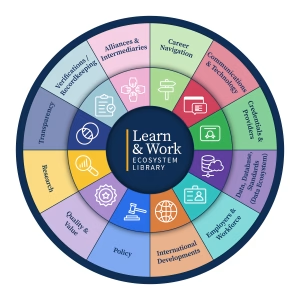

According to iCIMS (provider of talent acquisition software), sourcing is the ability to identify and classify candidates by skill and experience level, and then allocate them to open positions based on these metrics as the positions become available. The candidate’s resume then becomes available for the recruiter or hiring manager to contact the candidate.

opportunity@work defines STARS as individuals who may not have a four-year college degree but possess the skills for higher-wage work. They are typically at least 25 years old, active in the workforce, and have a high school diploma but not a bachelor’s degree. They have developed valuable skills on the job, through military service, in community college, or through other alternative routes. Research has found that millions of STARs have demonstrated skills for roles with salaries at least 50% higher than their current job. There are estimated to be more than 70 million workers in this category, and they constitute a major, large, and overlooked talent pool.

A model in which there is no dedicated central entity that coordinates the identification or the cultivation of new talent for state organizations. Each state agency is responsible for recruiting and hiring its own employees. This model is generally viewed as a flexible, responsive way to hire but there are fewer incentives for agencies to seek talent outside of their usual recruitment channels.

According to iCIMS (provider of talent acquisition software), Strategic Workforce Planning is the process of aligning your talent strategy with long-term business goals. It’s about anticipating workforce needs, identifying skill gaps, and ensuring your organization is equipped with the right people at the right time. The key benefits of SWP include improved talent retention, enhanced organizational agility, and the ability to adapt quickly to market changes.

According to iCIMS (provider of talent acquisition software), talent acquisition is the process of finding, attracting and engaging highly talented individuals and having them join an organization. It includes applicant tracking, onboarding, workforce planning, sourcing, recruitment marketing automation and more.

Talent assessment tools are used for pre-employment screening purposes, assessing candidates on their knowledge and skills, work style, and personality. Talent assessments can include multiple-choice questions, open-ended prompts, and questions requiring audio- or video-based responses.

A resource, framework, or playbook that helps organizations gather, analyze, and apply labor market data to inform workforce and hiring strategies. These guides are commonly used by HR professionals, education providers, policymakers, and workforce boards to navigate the evolving labor market, understand emerging skills, and support data-informed decision-making in hiring, upskilling, and strategic workforce planning. It typically includes:

  • Real-time labor market data sources (e.g., job postings, skills taxonomies, employment trends)
  • Taxonomies of skills and occupations
  • Analytical methods (e.g., AI-powered skills matching, skills gap analysis)
  • Best practices for aligning talent supply with demand
  • Case studies from companies and regions, or tools for making informed decisions about hiring, training, and workforce planning

Examples:

  • The World Economic Forum’s Talent Intelligence Platform (TIP) Playbook. This playbook outlines how to build a skills-based approach to workforce planning, including mapping current skills and supply and demand using taxonomies like ESCO and O*NET; and integrating skills data into HR systems.
  • Lightcast Talent Intelligence Playbook. Helps organizations assess the supply and demand for specific skills in local or national labor markets; identify skill gaps in their workforce; forecast talent needs based on emerging trend; and inform workforce development strategies such as training programs or recruitment efforts.

Alternative Terms:

  • Workforce Analytics Guide: Emphasizes the use of data science in HR and planning
  • Labor Market Intelligence Toolkit (LMI Toolkit): Public-sector term for data resources on jobs, skills, and trends
  • Talent Market Report: Shorter, insight-driven documents focused on workforce trends
  • Strategic Workforce Planning Framework: Broader strategy guide that includes talent intelligence as one part
  • Skills Intelligence Framework: Focuses specifically on skill-level data and emerging needs
  • Skills Taxonomy User Guide: A guide to using structured skill lists like O*NET or ESCO

A platform or interconnected system that matches individuals with employment, career, learning, or development opportunities based on their skills, experience, credentials, interests, and other relevant information. Talent marketplaces are designed to make people’s skills and available opportunities more visible and to improve connections between talent and opportunity.

Talent marketplaces are commonly used in two contexts:

  • Employer or internal talent marketplaces operate within an organization. They help employers identify and connect current employees with internal job openings, projects, temporary or stretch assignments, mentoring, professional development, and other opportunities. They can support internal mobility, employee development, skills identification, and more effective use of an organization’s existing talent.
  • State or regional talent marketplaces operate across a broader education and workforce ecosystem. They may connect job seekers, workers, students, employers, education and training providers, workforce organizations, and government agencies. These marketplaces can help individuals identify jobs and career pathways, help employers find people with needed skills, and connect education and training opportunities with labor market demand.

Many contemporary talent marketplaces use skills data and artificial intelligence (AI) to help identify and recommend potential matches. They may also incorporate or connect with skills profiles, assessments, credentials, credential registries, Learning and Employment Records (LERs), digital wallets, career pathways, learning opportunities, and labor market information.

In the United States, a growing number of states are developing talent marketplaces as part of broader efforts to build skills-based education and workforce systems. These initiatives may be developed through partnerships involving state agencies, employers, education and training providers, workforce organizations, intermediaries, technology providers, and philanthropic organizations.

Whether used within an individual employer or across a state or region, talent marketplaces generally seek to improve the visibility and portability of skills and create stronger connections among people, learning, and work.

According to iCIMS (provider of talent acquisition software), talent pipeline is a pathway between job seekers and employers. Organizations build a talent pipeline to create a supply of candidates it can access any time.

Talent pipelining is a type of proactive recruiting. It requires effort, strategy and maintenance. When it operates successfully, it provides organizations with a steady flow of high-quality applicants.

Your talent pool is your pipeline of top potential candidates.

The process of reshaping and developing individual or workforce skills, capabilities, and mindsets to adapt to evolving organizational, technological, and labor market demands. Talent transformation often involves reskilling and upskilling, career development, and the use of tools such as assessments, coaching, and technology-driven learning programs. It is both a personal and organizational strategy to align growth, adaptability, and long-term success.

Related Terms:

  • Workforce Transformation – broader organizational changes to workforce structures, roles, and capabilities.
  • Reskilling – training workers for entirely new roles or functions.
  • Upskilling – enhancing existing skills to meet evolving role requirements.
  • Human Capital Development – investment in people’s skills, knowledge, and abilities to increase economic and organizational value.
  • Career Pathways – structured routes for individuals to advance through learning and work.
  • Change Management – organizational strategies for guiding people through transitions.
  • Future of Work – trends shaping how work is organized, including automation, AI, and flexible work models.

According to iCIMS (provider of talent acquisition software), text recruiting software uses SMS, chat, and AI across multiple platforms to engage with candidates at scale. All communications are housed within a compliant platform, eliminating the need for recruiters to send texts to candidates from their personal phones.

This can include “Text to apply,” which enables candidates to send a word or code to a phone number to begin the application process. Once they send the code or keyword, they’ll receive an automatic response with further information. The candidate may receive a complete application, a document with more information, or a link to a form or website.

Refers to a trend that the skilled trades are newly appealing to the youngest generation of American workers (often called “Gen-Z”), many of whom are skipping a traditional college path after high school graduation in favor of the trades. Gen Z’s embrace of trades and vocational education reflects a pragmatic approach to career readiness—one which emphasizes skills over traditional college degrees. This trend is fueled by a shortage of jobs in the trades, rising pay, and new technologies in fields such as plumbing, welding, machine tooling, HVAAC, solar, construction, and the electrical occupations. These are all leading to new perspectives on the benefits of working in the trades. Educational paths to the trades are changing as well. At the high school level, this has resulted in many locations to acceleration of a three-track system that allows students to explore their interests in the trades and gain practical skills: (1) students take 2 years of foundational courses including math, science, history, and language (General Education); (1) in junior year, students choose two potential career tracks (Career Tracks); and (3) senior year focuses on a particular area of study related to a chosen career path (Specialization).

Refers to groups of the population that have historically held a smaller percentage of professional roles within a field or higher education institution as compared to the percentage of that group in the overall population. Examples of the characteristics these groups are based on include but are not limited to: race and/or ethnicity, sex and/or sexual orientation, religion, disability status, and age.

Offices operated by labor unions that help distribute job assignments to union members, often in skilled trades such as construction, maritime work, or longshoring. Employers contact the hiring hall when they need workers, and the union dispatches available members based on seniority, qualifications, or rotational systems. The purpose of union hiring halls is to match workers to jobs fairly and efficiently, ensure compliance with union contracts, and maintain job order and labor market balance within an industry.

The process of gaining new skills or knowledge, particularly in the context of adapting to economic and technological changes in the workplace. Upskilling can be achieved through traditional education, on-the-job training, or through professional development, and may include acquiring skills such as leadership and emotional intelligence in addition to more specialized technical or professional skills. Upskilling can also involve the use of emerging technologies like artificial intelligence and blockchain to enhance and deepen existing skill sets. Upskilling is different from Reskilling, which involves acquiring new skills and knowledge to transition into different jobs or fields. 

According to iCIMS (provider of talent acquisition software), video interviewing refers to an interviewing style which takes place remotely using digital video technology. Video interviews can be two-way, where both the interviewer and the job candidate are present during the video session, or one-way, where the candidate pre-records their interview with prompts from the recruiter.

According to iCIMS (provider of talent acquisition software), is a scheduled online event hosted on a single online channel that’s designed to connect large groups of candidates with recruiters. Candidates and talent acquisition professionals meet in a virtual space to discuss job opportunities.

This is part of a larger virtual recruiting strategy, where talent acquisition professionals make use of teleconferencing, virtual events, text engagement, and web-administered forms and assessments to conduct their recruitment efforts.

Future Forward Institute developed the Win-Win Workplace Framework to redefine the employer-employee relationship around a set of tools that CEOs, C-Suite leaders, small business owners, managers, and employees can draw on to co-construct a more sustainable, human-centered workplace. The framework is comprised of nine pillars posited as integral to driving business success:

  1. Centering Employee Voices—Creating formal channels for feedback from employees and using that feedback to improve the workplace.
  2. Cultivating Mutualistic Working Relationships—Building intentional positive and collaborative relationships between employees and employers.
  3. Implementing Intersectional Inclusion Strategies—Creating a workplace that is inclusive of all employees, recognizing each individual’s background and identities.
  4. Reimagining Employee Benefits—Offering a comprehensive benefits package that includes human-centered offerings such as parental leave, subsidized childcare, and dependent care.
  5. Implementing Frontline Leader-Driven Strategies— Empowering frontline leaders to champion inclusion initiatives.
  6. Hiring STARs (Skilled Through Alternative Routes) versus Prioritizing Credentials—Hiring candidates based on skills, talents, abilities, and results rather than solely on academic credentials.
  7. Developing Deep Talent Benches—Nurturing and developing talent within the organization to fill future leadership roles.
  8. Using Human-Capital Reporting as a Competitive Strategy— sing disaggregated human-capital data and metrics as part of decision-making.
  9. Distributed Leadership-Entrepreneurial Structures—Empowering employees throughout the organization to take ownership and make company decisions.

See: Research: Competitive Advantage of the Win-Win Workplace – Future Forward Institute, JUST Capital & Burning Glass Institute | Learn & Work Ecosystem Library

Refers to the essential competencies that employees need to perform effectively in their jobs. Core skills individuals need to navigate and succeed in the workplace commonly include communication, teamwork, integrity, problem-solving, work ethic, and initiative.

According to ACT (2013), A work ready individual possesses the foundational skills needed to be minimally qualified for a specific occupation as determined through a job analysis or occupational profile. The skills needed for work readiness are (1) foundational and occupation-specific, (2) vary in importance and level for different occupations, and (3) depend on the critical tasks identified through a job analysis or occupational profile.  Work readiness skills include:

  • Foundational cognitive skills such as reading for information, applied mathematics, locating information, problem solving, and critical thinking
  • Noncognitive skills or “soft skills” defined as personal characteristics and behavioral skills that enhance an individual’s interactions, job performance, and career prospects such as adaptability, integrity, cooperation, and workplace discipline.

In recent years, top work readiness skills commonly include:

  • adaptability and flexibility: embracing continuous learning
  • digital literacy: staying current with technology
  • critical thinking and problem solving: engaging in real-world scenarios
  • time management and organization: developing efficient work habits
  • cultural competence and inclusivity: fostering a diverse and inclusive mindset

Employability is a related though broader term than workforce readiness. It refers to the ability of individuals to find, create, and sustain meaningful work across their career and in different contexts while continuing to enhance their skills, attitudes, and attributes. Workforce readiness is a subset of employability—it refers to individuals’ perceived level of skills and attitudes that prepare them for success at work.

Many additional terms are also used to refer to work readiness, such as graduate skills, graduate attributes, key competencies,  job-readiness, work preparedness, transferable skills, generic attributes, graduate pre-professional identity, and graduate capital.

Organizations (554)

Initiatives (769)

Topic Briefs (163)
